BEAM COMBINERS COMPARED: DICHROIC MIRROR VS PBS CUBE
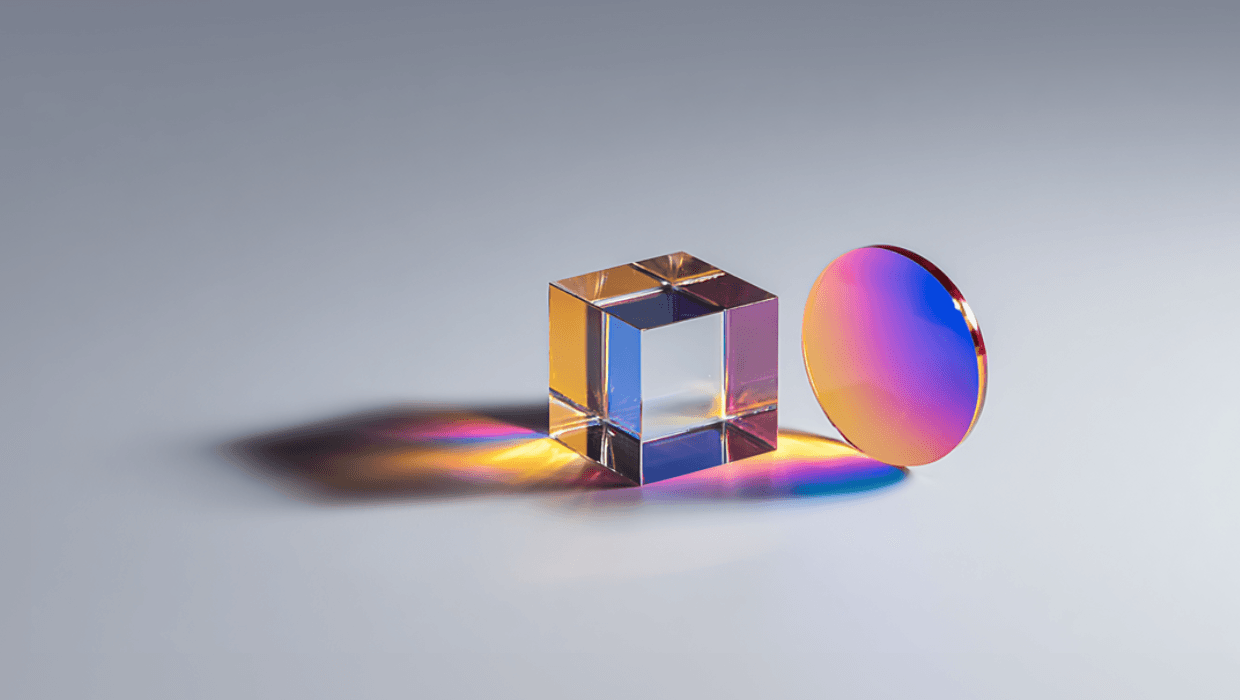
Dichroic mirrors and PBS cubes are the two most common components to combine multiple laser beams into a single optical path. Although both can operate over a wide spectral range, they use completely different physical principles: one combines by wavelength, the other by polarization. This comparison explains when each option works best, when it fails, and how to choose the right combiner for your laser setup.
When to use dichroic mirror as beam combiner?
A dichroic mirror (beam combiner) reflects one wavelength band and transmits another. At 45° the coating shows some polarization dependence, while near 0° the it is almost polarization neutral. Dichroic mirrors are a practical choice when polarization cannot be controlled, would require additional polarizers to adjust, or simply doesn’t matter for the application.
Nd:YAG beam combining (1064, 532,355, 266 nm)
Nd:YAG laser systems often combine multiple harmonics into a shared optical path using dichroic mirrors. They typically transmit 1064 nm and reflect its harmonics (532 nm, 355 nm, 266 nm). Alien Photonics Nd:YAG beam combiners make coaxial alignment of the pump and harmonics straightforward, even in very compact or high-precision micromachining setups.
Raman Beam Combining (532, 633, 671, 785)
Raman combiners combine the Raman pump laser (typically 532 nm, 633 nm, 671 nm, or 785 nm) with the Stokes-shifted Raman signal (600–900 nm for 532 nm pump or 850–1050 nm for 785 nm pump). Reflecting the pump and transmitting the Raman band allows both beams to share a single coaxial optical path.
UV–VIS Beam Combining (355, 405, 450 nm)
Dichroic mirrors in the UV–VIS range are commonly used to combine two lasers beams, such as 355 nm, 405 nm, and 450 nm into a single one. By reflecting the shorter-UV wavelength and transmitting the longer-VIS band (or vice versa), Alien Photonics UV-VIS Beam combiners provide low-loss coaxial alignment for microscopy, fluorescence excitation and compact OEM modules.
Infrared Beam Combiners
To produce infrared dichroic mirror, dichroic coatings on ZnSe, ZnS, Si or Ge infrared substrates are applied. It typically reflects the shorter-IR band and transmits the longer-IR wavelengths (vice versa options are also available). Infrared coatings allow combining two IR beams by reflecting the shorter-IR wavelength (in the range 1-3–5 µm) while transmitting a longer-IR band (e.g., 5-8–12 µm), with inverse configurations also available.
When to use PBS cube as beam combiner?
A broadband PBS cube combines two beams of same wavelength range by passing one polarization and reflecting the other into the same output path. It’s very simple way to merge laser beams when you can rotate one beam by 90°.
Fiber Laser Combining (1030, 1064 nm)
While steep-transition dichroic mirrors for 1030/1064 nm exist, they are angle-sensitive and often expensive. In practice, a broadband PBS is the standard and most stable way to merge these two IR wavelengths into a single beam.
UV Laser Combining (400, 405 nm)
400 nm and 405 nm differ by only 5 nm. The distance is too small for dichroic transition—so a UV PBS is the most realistic way to combine these two UV wavelengths.
Combining Solid-State Lasers (Nd:YAG, Ti:Sapphire, Yb:YAG)
PBS combiners are widely used to merge identical-wavelength beams from solid-state lasers such as:
- Nd:YAG combines 532 with 532 nm or 1064 and 1064 nm, etc.
- Ti:Sapphire (800, 400 nm)
- Yb:YAG (1030 nm, or harmonics). By using orthogonal polarizations, PBS combining offers clean, efficient and alignment-stable power scaling, making it ideal for multi-head and high-power laser architectures.
Combining High-Power Fiber Lasers with PBS (1070 nm)
High-power industrial fiber lasers operating around 1070 nm are often combined using PBS cubes, since polarization-based merging delivers low absorption, strong thermal stability and reliable power scaling at hundreds of watts or even kilowatt levels. When paired with high-energy PBS cubes, this technique provides efficient way to merge multiple high-brightness fiber sources into a single beam.
Which beam combiner to choose - Dichroic Mirror or PBS cube?
Let's compare All Alien Photonics PBS cubes and Dichroic Mirror.
| Feature | PBS (Standard) | PBS (High Energy) | PBS (Broadband) | Dichroic Mirror |
|---|---|---|---|---|
| Budget-friendliness | 5 | 3 | 2 | 2 |
| Ease of handling | 4 | 5 | 5 | 3 |
| LIDT | 1 | 5 | 2 | 4 |
| Thermal stability | 1 | 4 | 4 | 5 |
| Combines two different wavelengths | NO | NO | YES | YES |
| Combines two identical wavelengths | YES | YES | YES | NO |
| Combines two polarizations | YES | YES | YES | NO |
Verdict and Alien Photonics recommendation
Dichroic mirrors are an excellent choice when polarization does not matter or cannot be controlled. They are ideal for combining different wavelengths (especially if they are far apart) with minimal optical loss.
Single-band PBS cubes (standard and high-energy) are essentially irreplaceable whenever you need to combine two beams of the same wavelength.
Broadband PBS cubes can replace dichroic mirrors when you can control the input polarizations. They are also very useful when wavelengths are very close (e.g. 400 and 405, 1064 and 1070 nm, etc.).
Still not sure which one to choose? Contact us for consultation!