HOW KTU STUDENTS TACKLED AN ALIEN PHOTONICS CHALLENGE
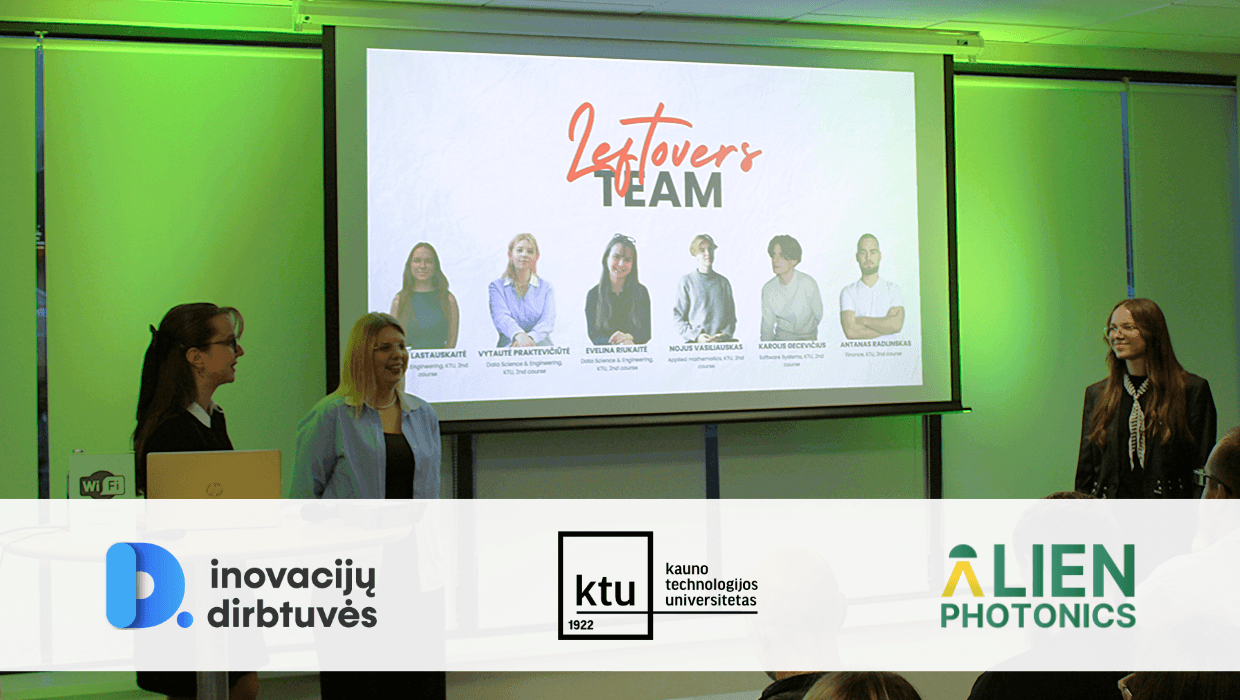
Alien Photonics is a provider of optical components to research and industry. During the Inovacijų Dirbtuvės program, the company hosted six KTU students for an internship focused on exploring an AI-based solution concept to support Alien Photonics customer service.
Who They Are
Evelina, Vytautė, Antanas, Gustė, Nojus, and Karolis are students of Kaunas University of Technology (KTU) and members of the KTU Gifted program. The team was well-balanced, combining different skills, perspectives, and backgrounds.
Inovacijų dirbtuvės
Inovacijų Dirbtuvės is a two-month program connecting students with companies. During the program, student teams work on a real business challenge proposed by a company. By the end of the program, teams deliver a concept, prototype, or demo, depending on the challenge.
Why Alien Photonics Was Chosen
Alien Photonics was chosen because its catalog contains highly technical optical components with many similar variants, making it an effective environment for testing AI-based assistance.
Industry-Academia Collaboration
Collaborations between universities and deep-tech companies help bridge the gap between academic knowledge and industrial realities. Inovacijų Dirbtuvės plays this role, and the Alien Photonics challenge shows how cooperation can generate practical insights for both students and the company.
What they've worked on
Optical Components and Product Understanding
The students gained a deeper understanding of lasers and optical components, focusing on how such products are specified, selected, and applied. Their work included analysis of components such as high-energy waveplates, broadband PBS cubes, thin-film polarizers, and dichroic mirrors, as well as custom optics used in laser processing, quantum computing and other applications.
Building a Foundation for Further Development
Rather than aiming for a final product, the team focused on establishing a clear foundation for future development. This included defining workflows, logical structures, and key decision paths that could later be extended into a more advanced solution.
Conducted market research and financial analysis
Market Research
The research covered both photonics-related aspects and AI-based customer support solutions. It included analysis of potential costs, time savings, and practical limitations of using AI in a highly technical sales environment.
Financial Analysis (ROI)
The students evaluated development and maintenance costs and estimated how quickly such a solution could reach a break-even point under realistic assumptions.
What was NOT the goal?
The goal was not to build a fully autonomous chatbot or replace sales engineers. Instead, the focus was on understanding where AI can realistically assist in a photonics environment by filtering information and reducing repetitive work.
Impact on Customer Service
As the Alien Photonics product catalogue continues to grow, an AI-based solution could help identify relevant components faster than manual or traditional search methods, especially for complex technical queries.
Real Industry Context
Unlike generic e-commerce use cases, photonics requires precise specifications and application-specific constraints. This exposed students to real industry conditions, where incorrect recommendations like slightly different wavelength or incorrect angle of incidence have tangible technical and financial consequences.
The challenge gave KTU students the opportunity to apply theoretical knowledge in a real deep-tech industry context, working with complex photonics products. It also highlighted the value of structured collaboration between academia and industry in developing practical, skills-driven experience.