POLARIZERS FOR LASER POWER ATTENUATORS
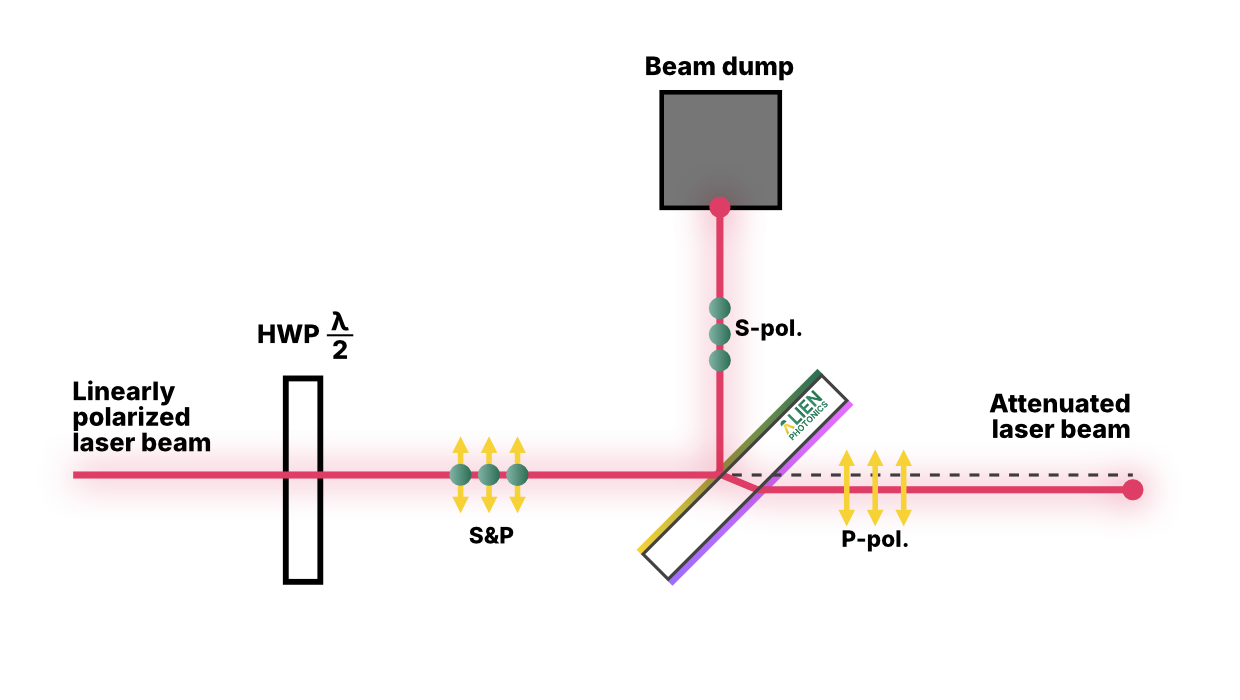
Laser power attenuator is a combination of a half-waveplate with PBS cube or TFP plate. In the basic design light passes through a waveplate and then split by polarizer. P-pol is transmitted and S-pol is reflected. By adjusting the waveplate it is possible to fine-tune the transmitted beam power.
How to choose a waveplate for attenuator?
Alien Photonics offers very wide range of waveplates, and most of them could be used in attenuators. Important factors to consider are - construction, order and wavelength range.
Construction
Glued waveplates are not suitable for attenuators, as the optical adhesive limits LIDT to approximately 0.1~0.3 J/cm² @ 1064 nm, 10 ns, 10 Hz. Other options - bonded, air-spaced and single plate - are all suitable.
Waveplate order
Low order, true zero order single plates, both bonded and air-spaced zero order waveplates are well suited for attenuators working at specific laser wavelengths. We suggest using true zero order to minimize thermal effects, or air-spaced for high powers. You can learn about the difference between waveplate orders in Alien Photonics guide.
Wavelength range
Alien Photonics air-spaced achromatic waveplates ensures constant retardation over wide wavelength range (e.g. 470-650 nm; 650-1100 nm; 1000-1700 nm or custom range), these waveplates are the to-go choice for broadband attenuators.
PBS cubes for attenuators
Alien Photonics offers PBS cubes that can be used in attenuators, but some critical factors must be considered.
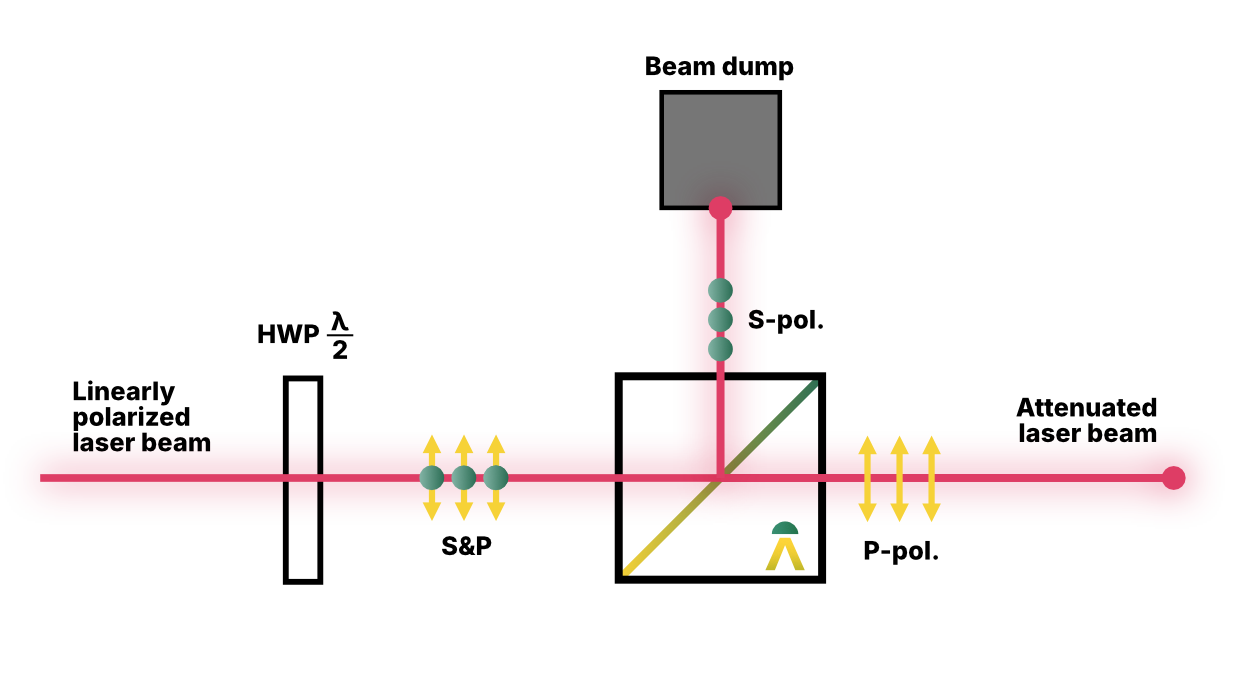
Cube construction
Optically contacted PBS cubes can be used in attenuators. Similarly to waveplates - glued option is not suitable as LIDT is very limited. Learn more about glued and optically contacted cubes in our article.
Wavelength range and contrast
While broadband PBS cubes can cover wide range, this coating design limits extinction ratio to Tp:Ts 250:1 (can be better for narrower ranges). Alien Photonics high power single band PBS can be designed to Tp:Ts 1000:1.
Thin film polarizer plates in attenuators
Very strong alternative to PBS cubes - Alien Photonics TFP plates - no glue, no complex construction, but some fine tuning.
Brewster or custom angle?
While custom angle TFP plate can be easier replacement to pbs cube in already designed system, the Brewster TFP could require additional adaptation.
Extinction ratio
The extinction ratio (Tp:Ts) of Brewster TFP plate is typically better than custom angle TFP. ER is up to 3000:1, in some special cases even 5000:1 can be achieved. This allows high polarization purity while maintaining LIDT.
PBS or TFP?
When choosing between PBS cube and TFP plate for attenuator several factors should be considered.
| Feature | PBS | TFP |
|---|---|---|
| Typical LIDT (@1064 nm, 10 nm, 10Hz) | >15-20 J/cm²; | >20 J/cm²; |
| Typical ER(Tp:Ts) @ 1064 nm | 1000:1 | 1000:1 ~ 3000:1 |
| Beam displacement | None | Yes |
More about differences in PBS and TFP in our comparison article.
Integration & Common Pitfalls
Even with the highest-quality polarizers from Alien Photonics, the performance and longevity of your attenuator depend on proper optical layout and alignment.
Beam Dumping for Rejected Power
In high-power systems, the reflected s-polarized beam carries substantial energy (typically up to 99%~99.9% of input power at maximum attenuation). This rejected beam must be safely directed into an external cooled beam dump, to avoid stray reflections, scatter, and localized heating of mechanical mounts.
Preventing Back-Reflections
Even with anti-Reflective (AR) coatings, a waveplate placed perfectly perpendicular to the laser beam will reflect a tiny fraction (of light directly back into the laser resonator. In ultra-fast or highly sensitive laser systems, this can cause mode-hopping or instability. Solution: Slightly tilt the waveplate assembly by approximately 0.5°–1° relative to the optical axis. This minor tilt is enough to misalign back-reflections away from the laser cavity without affecting the retardation performance.
Orientation of the PBS Cube
Alien Photonics PBS cubes typically feature an orientation mark (arrow) indicating the intended input face, because cubes are asymmetric regarding their internal coating face. Pitfall: Installing a PBS cube backward can have an impact on the coating performance, or in extreme cases even damage the cube.