

Polarizing Beam Splitter (PBS) Cubes
Products
Polarizing beamsplitter cubes overview
Polarizing beam splitter cubes are essential components used in laser systems, scientific instruments, and optical setups requiring precise polarization control. Alien Photonics PBS cubes can be sorted by types – low & medium energy, high energy, and broadband – covering a wide range of applications from general laboratory use to high-power laser systems.
What is PBS cube?
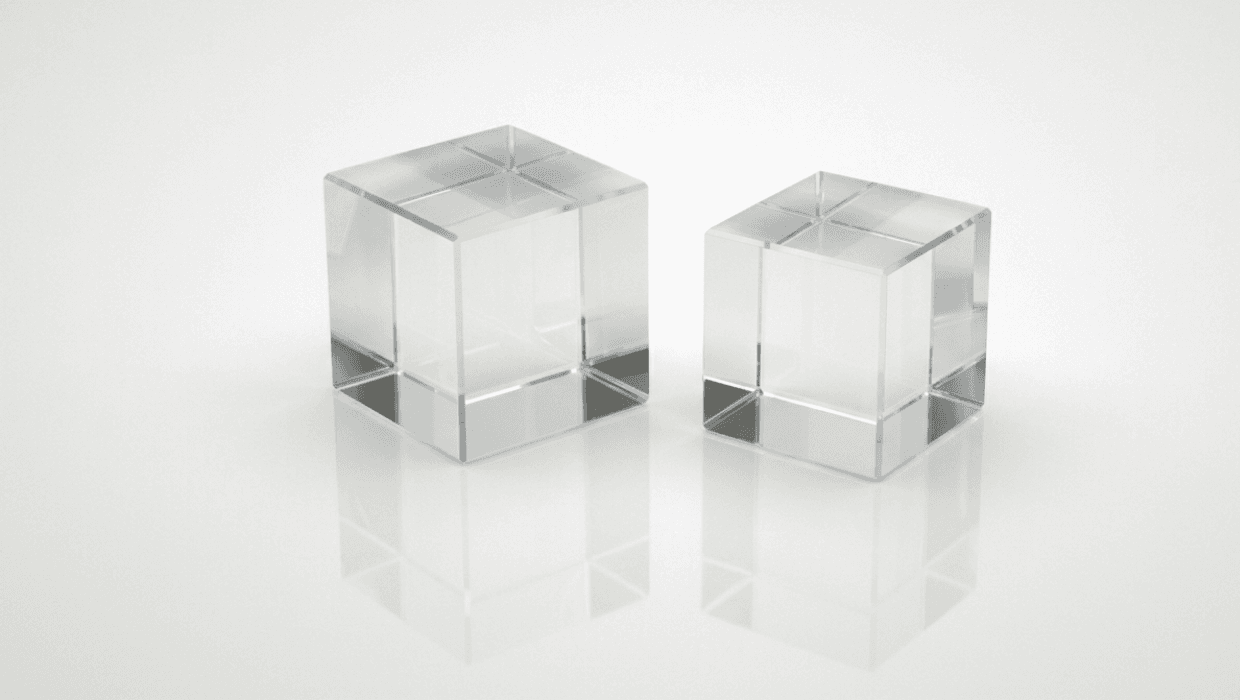
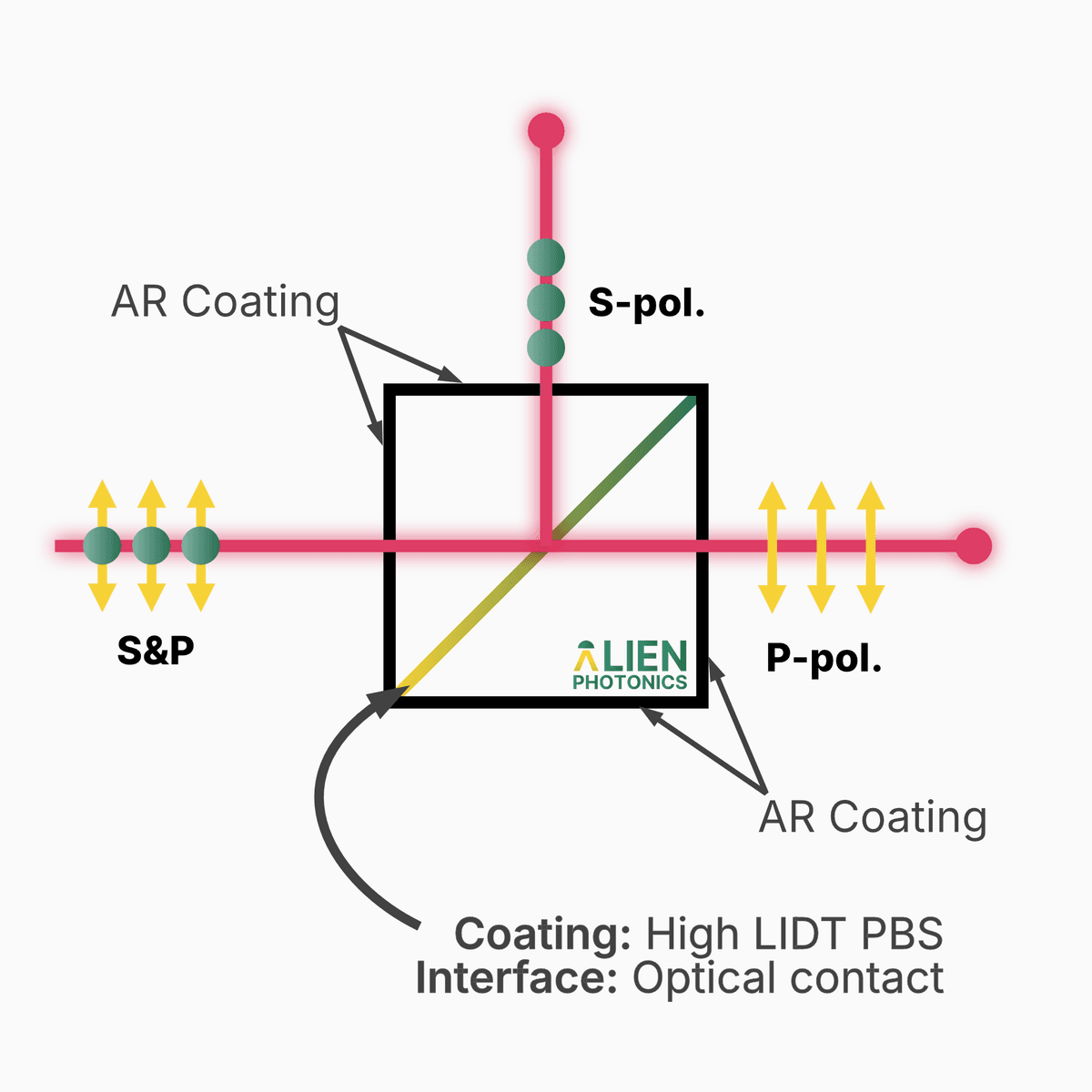
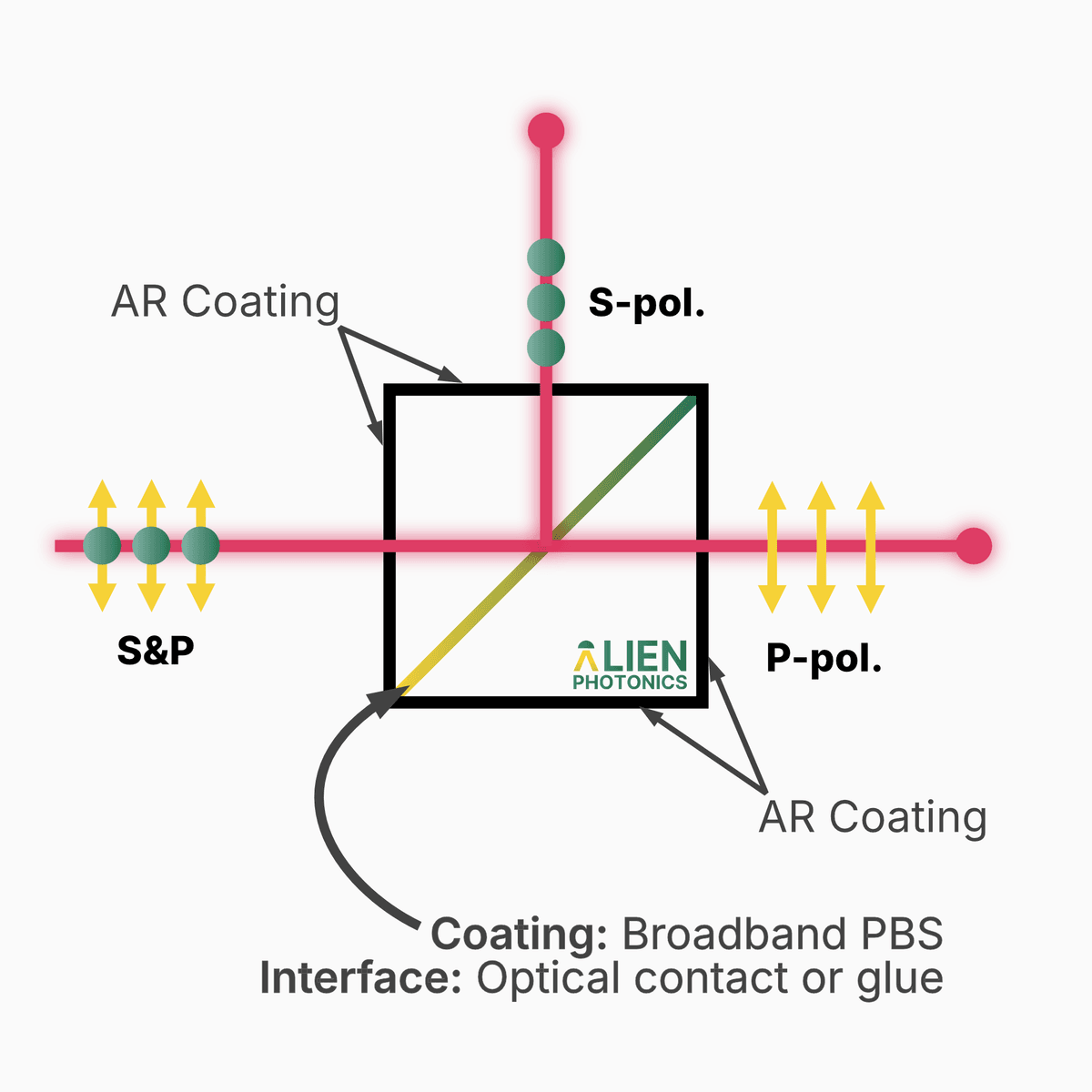
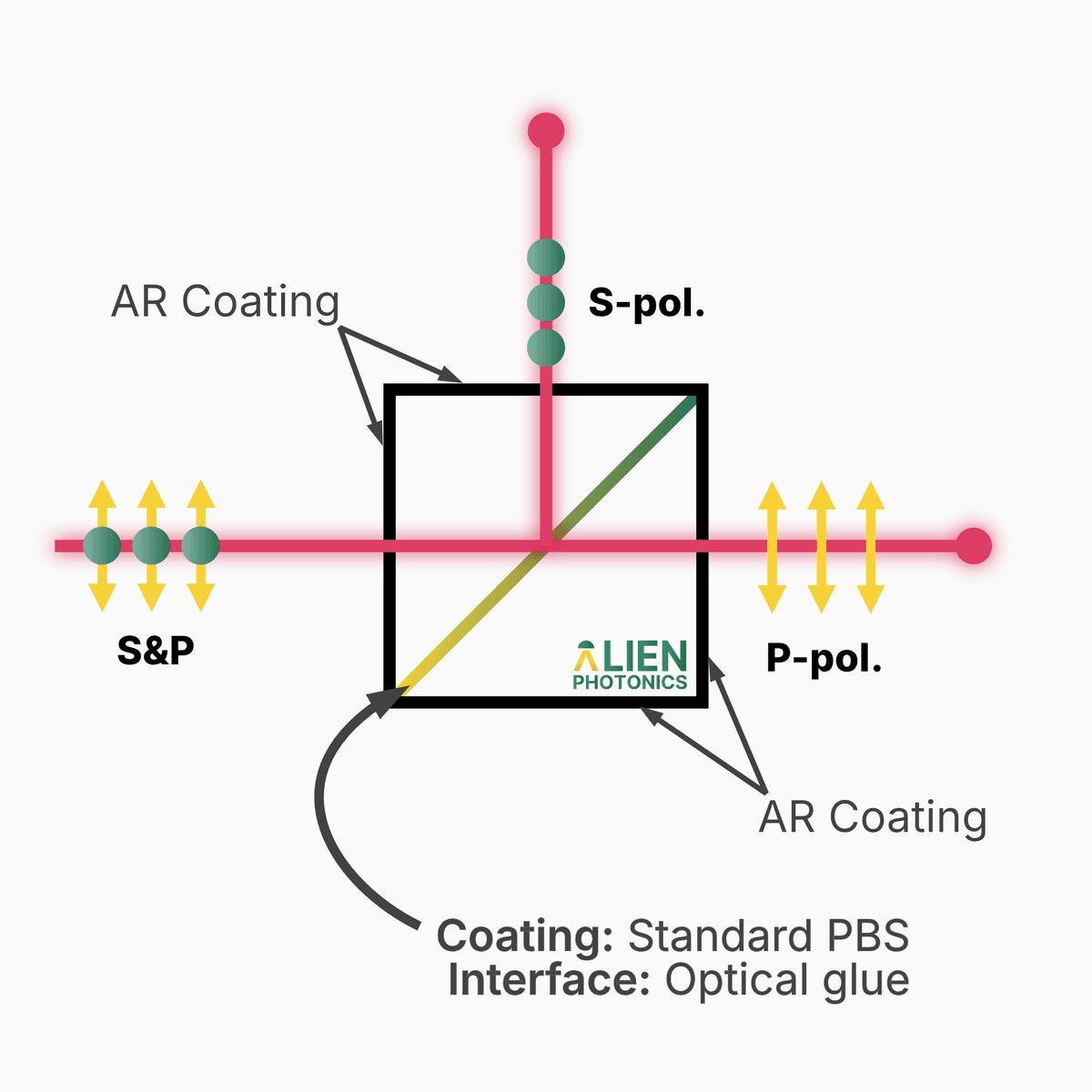
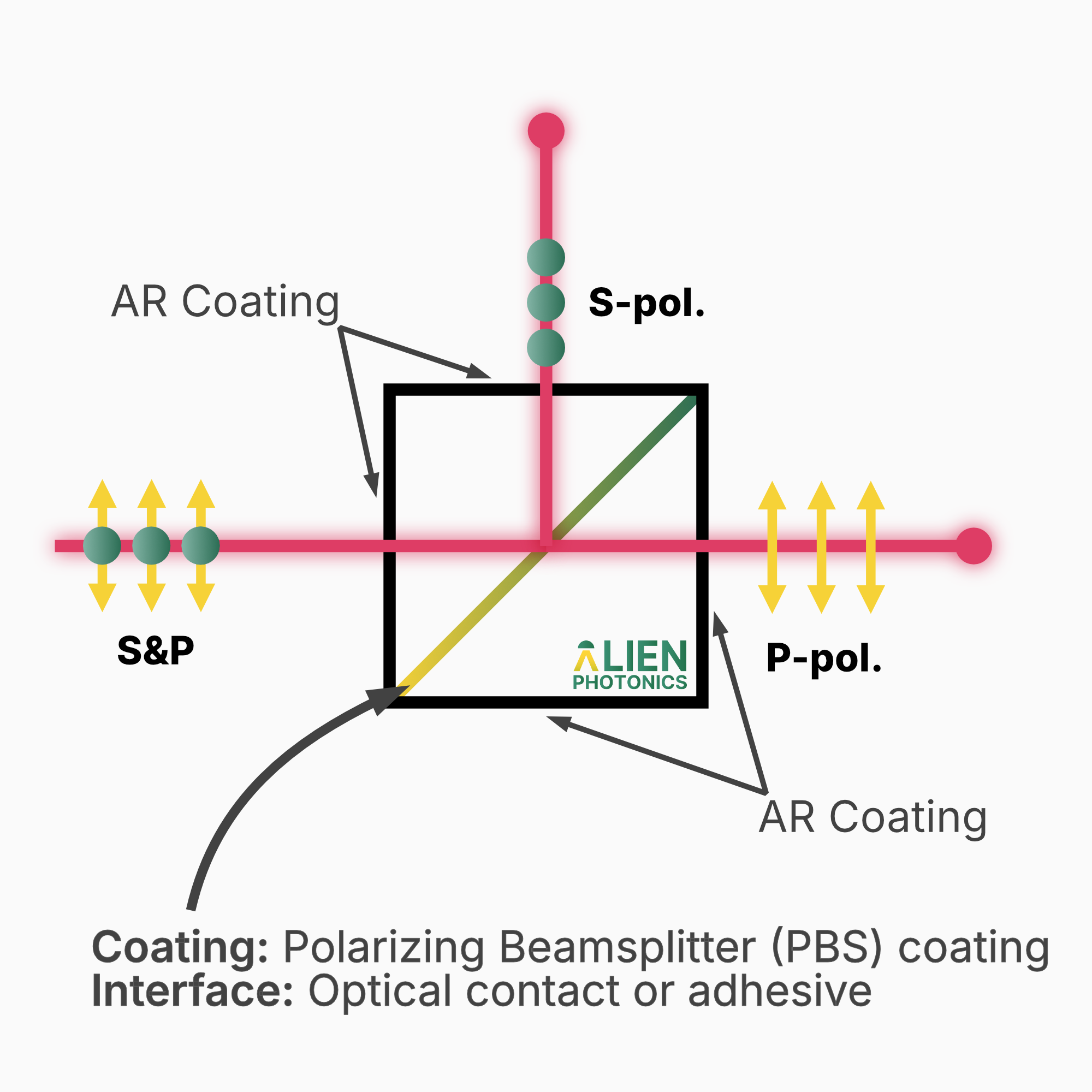
Polarizing beamsplitter cubes (PBS cubes) are optical components (polarizers) designed to split a light beam into two orthogonal polarization components. The transmitted beam carries P-polarized light, while the reflected beam carries S-polarized light. Alien Photonics PBS cubes are widely used in laser systems, scientific instruments, and anywhere precise polarization control or beam splitting is required. Unlike plate polarizers, the cube geometry minimizes ghost reflections and keeps the transmitted beam displacement small, simplifying optical alignment.
What is the principle of polarizing beam splitter cube?
When unpolarized or mixed polarization light enters the PBS cube, it is separated based on polarization orientation. P-polarized component continues forward, S-polarized component exits at 90°. Both output beams are linearly polarized.
Production of PBS cubes
PBS cubes are made from two right angle prisms. One prism is coated with beamsplitter coating, enter and exit surfaces with AR coating. Next – joining prism by combining them with optical adhesive or optical contact. Once cubes are produced – final quality inspection is done. the More about manufacturing process in detail is covered in our article about PBS cube production.
Choosing between Alien Photonics PBS cubes
Similar cubes - different parameters
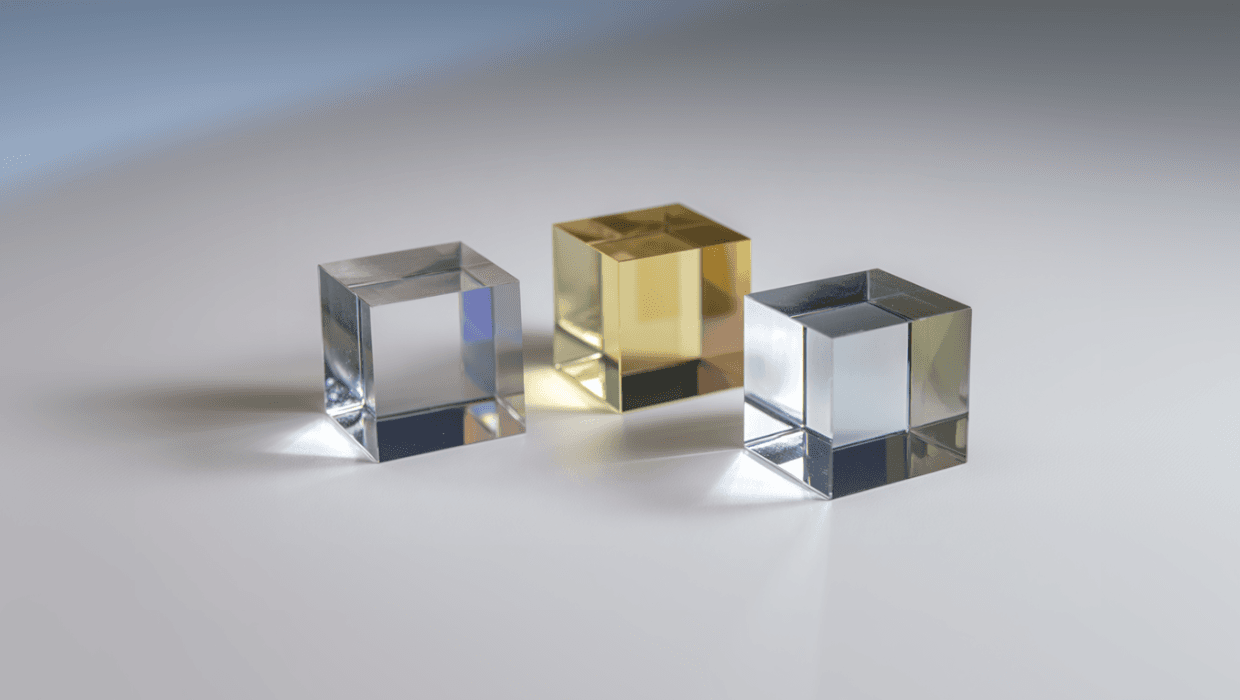
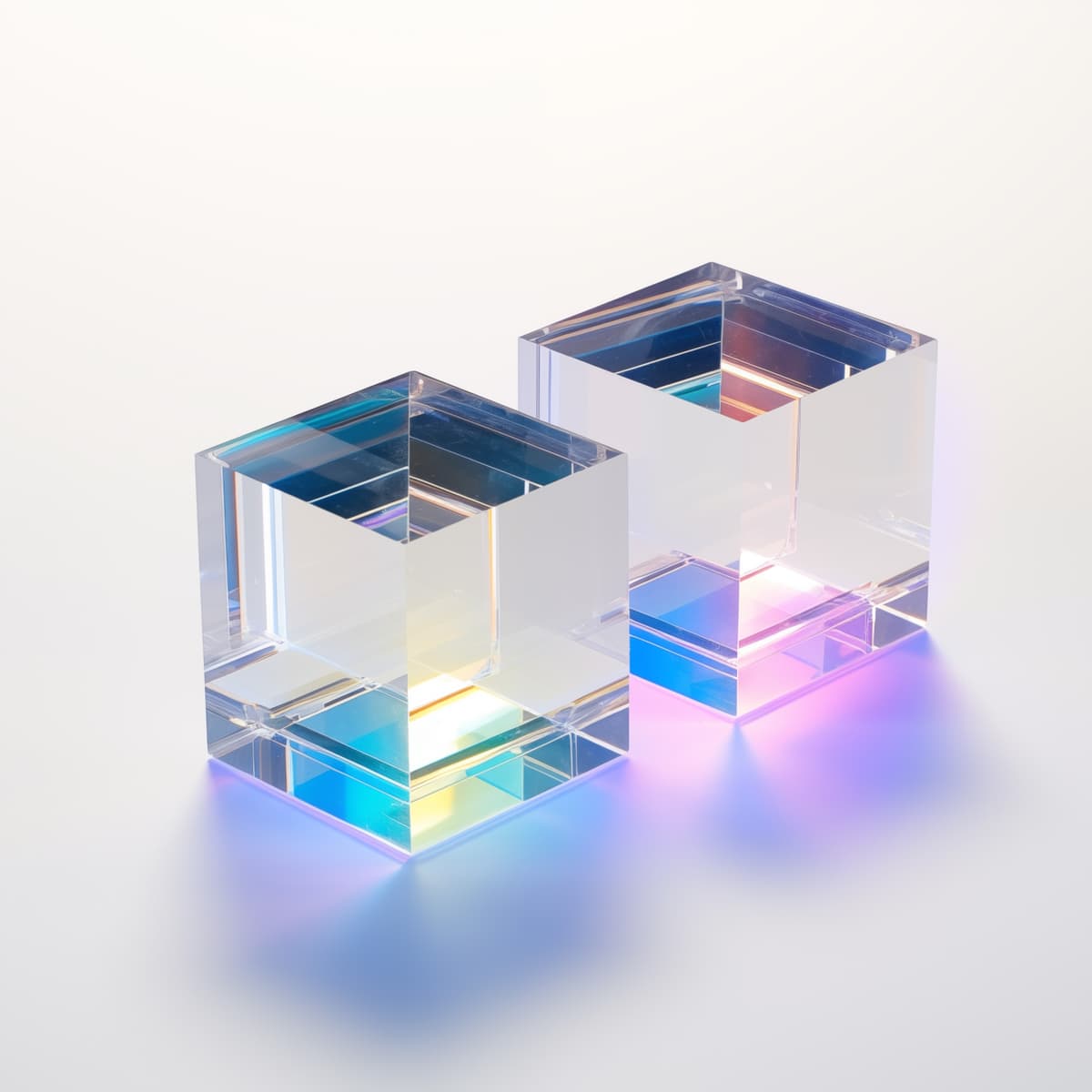
All types of PBS cubes visually might look very similar, but the key differences lie in details. Size, material, surface quality and other physical parameters might be common between all cubes. Polarizing beamsplitter cubes can be distinguished between themselves by wavelength range (single or broad), laser damage threshold (low or high), prism combining method (adhesive or glue), extinction ratio and others.
Extinction Ratio
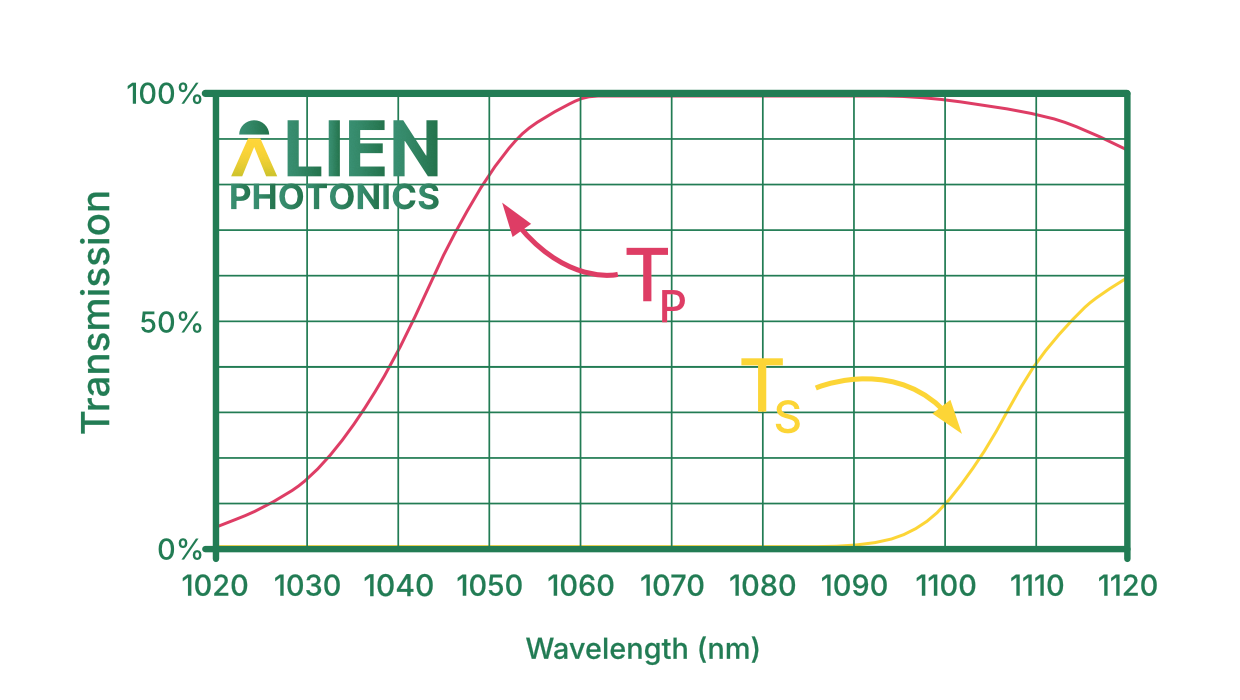
PBS cube extinction ratio (Tp:Ts) describes how well the two polarization states are separated. A ratio of 500:1 means that for every 500 units of correctly polarized light transmitted, 1 unit of unwanted polarization leaks through. In most general laboratory applications, 500:1 or 250:1 is sufficient. However, in sensitive measurements such as ellipsometry, polarimetry, or quantum optics experiments, even small leakage of unwanted polarization can affect results. For these and similar applications Alien Photonics recommends 1000:1 or higher extinction ratio. It is worth noting that extinction ratio changes (gets worse) when PBS cube is used outside its specified wavelength range.
Key differences between PBS cubes
| Feature | Low-medium energy PBS | Broadband PBS | High energy PBS |
|---|---|---|---|
| Material example | N-BK7 | N-SF1 | UVFS |
| Surface quality | 40-20 S-D | 60-40 to 40-20 S-D | 40-20 or 20-10 S-D |
| Flatness & TWFD (Typical) | λ/4~λ/6 | λ/4~λ/8 | λ/4~λ/8 |
| Combining method | Optical adhesive | Optical adhesive or contact | Optical contact |
| Beam Deviation (Typical) | <3 arcmin | <3 arcmin | <3 arcmin |
| Reflection (Rs) | >99.5% | >99% | >99.5% |
| Transmission (Tp) | >97% | >92% (avg.) | >97% (and lower for UV) |
| Extinction Ratio (Tp/Ts) | >500:1 | >250:1 | >1000:1 |
| LIDT | ~0.3 J/cm² | 0.3-3 J/cm² | >15~20 J/cm² |
You can find more information and details about each specification in our guide for PBS cube parameters.
Custom PBS cubes
Custom PBS cubes are available when standard options do not meet your requirements: non-standard dimensions, specific wavelength ranges not covered by catalogue options, or special material requirements, clear aperture restrictions, high extinction ratio – most of parameters can be adjusted. Alien Photonics custom PBS cubes come in small and large batches – contact us to discuss your requirements.
PBS cube – alternative to other optical components
PBS cube as an alternative to TFP plate
Major advantage of PBS cube over Thin Film Polarizer (TFP) plate is the robust geometry, which allows to save lots of time on alignment, and that optical path length is kept for both (S and P) polarization components. Check our article explaining the differences PBS cube and TFP plate.
PBS cube as an alternative to dichroic mirror in beam combining
PBS cubes (both low-energy and high-energy) are essentially irreplaceable whenever you need to combine two beams of the same wavelength and broadband PBS cubes can substitute dichroic mirrors when you can reliably control the input polarizations. We suggest our guide about choosing the beam combiner – PBS cube or dichroic mirror.
PBS cube application areas
Laser micromachining
Polarizing beamsplitter cube filters out light based on polarization. It is especially useful in laser micromachining - processing birefringent materials to control the unwanted side effects, like blur, heat induced damage).
Quantum and optical computing experiments
PBS cube can be used in quantum computing setups for entangled pair generation. Check Alien Photonics article on beamsplitters in quantum computing.
Tunable and broadband laser systems
Alien Photonics broadband PBS cubes are well suited for tunable and broadband laser systems, where the operating wavelength changes or spans a wide spectral range. Our broadband polarizing beamsplitter cubes maintain consistent extinction ratio (1:250 or better) and transmission (T(avg.) >92% or better) across the full working range.
Imaging and machine vision systems
By filtering out one polarization state, Alien Photonics PBS cubes with extinction ratio 1:500 or 1:1000 removes specular reflections from shiny surfaces. This improves image contrast and feature visibility. If machine vision system operates across multiple wavelengths or use broadband illumination sources, a broadband PBS cube with extinction of 1:250 ensures consistent polarization performance across the full spectral range of the imaging system.
Role in scientific research and development
PBS cubes are a practical choice for research and development environments, where setups are frequently rebuilt and realigned. Geometry simplifies mounting and alignment, which matters when optical setups change often. As current research topics are often aimed at more powerful lasers, Alien Photonics PBS cubes are an excellent component for high-power laser research at universities and institutes across the world.
Pulse pickers
Let's review the basic concept of pulse picker – combination of Pockels cell and Alien Photonics PBS cube. When the electrical signal is applied, the Pockels cell changes the polarization of the laser beam, which allows pulse to pass through a PBS cube and reach the output. When the electrical signal is off, the Pockels cell does not change the polarization – all pulses are reflected by the polarizer and doesn't reach the output.
SHG, THG and OPO/OPA stages
PBS cubes are also used in nonlinear optical setups such as second and third harmonic generation (SHG, THG) and optical parametric oscillator or amplifier (OPO/OPA) stages. In these systems, Alien Photonics PBS cubes separate or combine pump and seed beams based on their polarization states. This separation allows precise control over beam routing without introducing additional losses from dichroic mirrors or other optical components.
Laser power attenuators
PBS cube in combination with a half-waveplate acts as a power attenuator. In this setup light passes through a waveplate and then split by PBS cube. P pol is transmitted and s-pol is reflected. By adjusting the waveplate it is possible to fine-tune the transmitted beam power.
Cleaning and handling PBS cubes
PBS cubes require careful handling due to their coated surfaces and cemented or optically contacted interface. Always handle PBS cubes with clean gloves or optical tissue – fingerprints introduce contamination that is difficult to remove without risking surface damage. When cleaning, use appropriate optical solvents and a lint-free optical tissue with a gentle drag stroke. Avoid any pressure on any of the surfaces. Never attempt to clean the interface between the prisms, as solvents can damage the optical adhesive or compromise the optical contact bond. If you have any questions on cleaning – contact us for advice.
Why choose Alien Photonics PBS cubes
Alien Photonics PBS cubes are manufactured with optical contact and optical adhesive combining options available for all power ranges. Small and custom batches are welcome - from single prototype for university research to larger OEM quantities. Alien Photonics ensures consistent quality across batches. Whether you need a standard wavelength PBS cube or a custom specification – contact Alien Photonics
FAQ
What is the difference between PBS and NPBS cube?
PBS cube splits light based on polarization. P-polarized light is transmitted, S-polarized is reflected. NPBS cube splits light by intensity regardless of polarization, typically 50/50, but Alien Photonics can offer 30/70 and other combinations. Choose PBS when polarization control is required, NPBS when you need to split a beam without affecting its polarization state.
Can PBS cube be used as a beam combiner?
Yes. PBS cube can work in reverse – two beams of orthogonal polarizations entering from different ports are combined into a single output beam. This is commonly used in laser systems and interferometers. Learn more about in our guide for beam combiners.
What extinction ratio do I need?
For general laboratory use, 250:1 or 500:1 are likely sufficient, sometimes even as low as 50:1 can be used. For sensitive experiments 1000:1 or higher is recommended. In some cases (especially UV) very high extinction ratio can be difficult to achieve with standard materials, due to absorption and other factors. If you are unsure, contact Alien Photonics to discuss your application.
What is the difference between optical contact and glued PBS cube?
Optical contact cubes have no adhesive at the interface – the prisms are bonded by molecular forces. This results in higher LIDT, better temperature stability, and longer shelf life. Glued cubes use optical adhesive, which limits power handling but is more economical. See our detailed comparison.
Can PBS cube work at multiple wavelengths?
Standard narrowband PBS cubes are optimized for a single wavelength or narrow range. For multi-wavelength or tunable applications, broadband PBS cubes or custom PBS are the correct choice.
What happens if I use PBS cube outside its specified wavelength range?
Extinction ratio degrades significantly. The coating is optimized for a specific wavelength or range. Outside this range, polarization separation becomes incomplete and both outputs will contain mixed polarization states.
What is the price of PBS cube?
Standard PBS price is about 100 €, while typical high energy PBS price is about 150€, Broadband PBS price is about 170€. Smaller and glued cubes can cost less. It also depends on quantity and fixing technology.
What is delivery time of PBS cube?
If in stock - next day. Production could take 2-8 weeks. Very custom options might take 10-12 weeks.
What is LIDT of PBS cube?
Standard cubes are limited by optical adhesives to about 0.3 J/cm² @ 1064 nm, 10 ns, 10 Hz. Optical contact option >3-20 J/cm² @ 1064 nm, 10 ns, 10 Hz. LIDT highly depends on coating design.