POLARIZERS FOR LASER PULSE PICKERS
Polarizer combined with Pockels cell are the two most important components of electro-optic pulse picker - electrically controlled optical switch designed to pick certain pulses from a pulse train (e.g. transmit only specific pulses while blocking all the others). Alien Photonics offers common polarizers - PBS cubes and TFP plates for laser pulse pickers.
The Dual-Polarizer Architecture: Input Cleanup vs. Output Selection
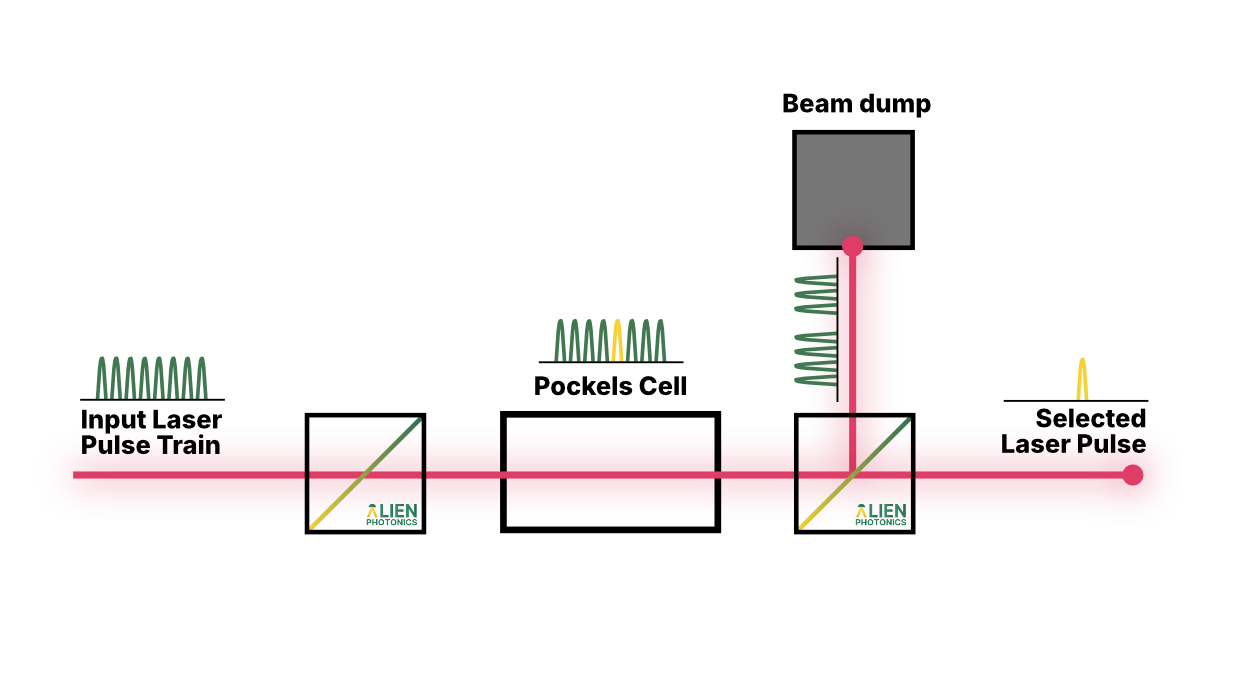
Pockels cells alone cannot block or select light - only rotate the polarization state. First polarizer cleans the polarization before the Pockels cell and second – actually separates the pulse from the train.
The Input Polarizer or Cleaner (First polarizer)
While most current lasers output a clean linearly polarized beam, thermal drift, stress birefringence in transport optics, or fiber delivery systems can degrade polarization purity. The input polarizer acts as a strict cleanup filter. It ensures that only a perfectly linear polarization state enters the Pockels cell crystal. Without this initial stage, any unpolarized or cross-polarized light component will pass through the system uncontrolled, immediately affecting the performance of pulse picker.
The Output Polarizer or Analyzer (Second polarizer)
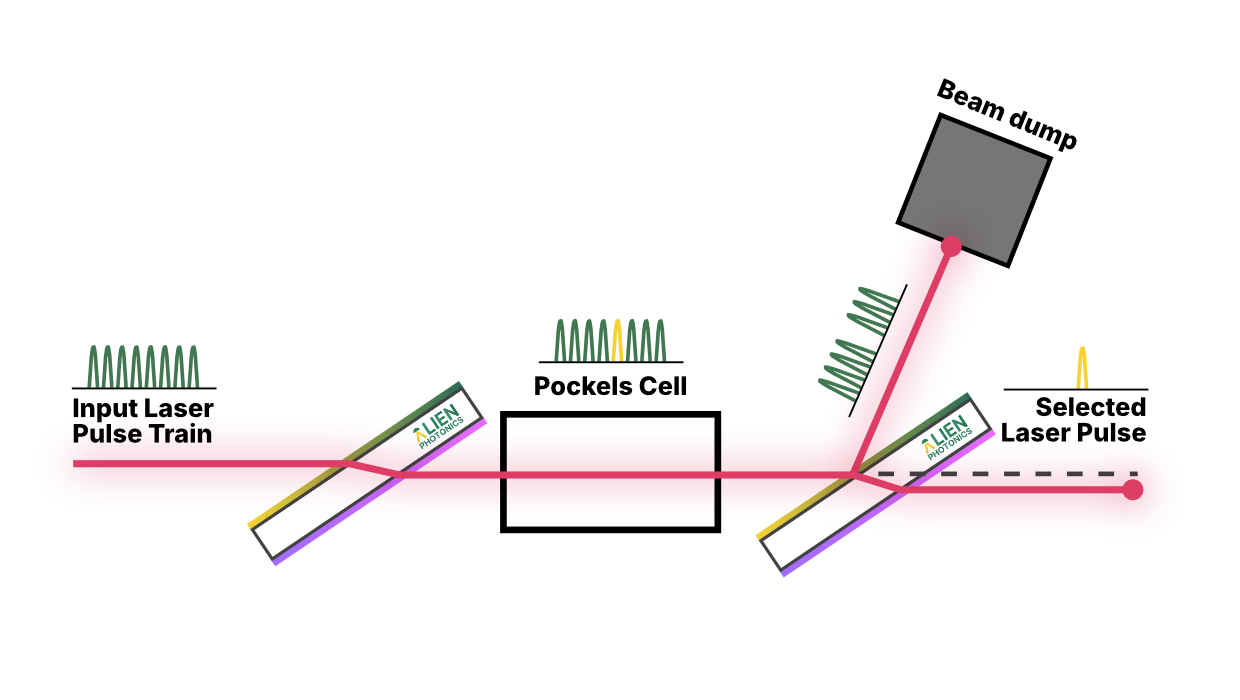
Placed after the Pockels cell, this polarizer serves as the physical gatekeeper of pulses. When the high-voltage pulse generator is off, the analyzer rejects the main pulse train, directing it safely to a beam dump. When the voltage flips the polarization of a selected pulse by 90°, this second polarizer allows that picked pulse pass through while still reflecting remaining pulses.
PBS cubes for pulse pickers
PBS cubes consist of two right-angle prisms glued or optically contacted together along the hypotenuse interface, which is coated with polarizing coating. High energy optically contacted PBS cubes rely strictly on internal 45° coated interface without the geometric benefit of Brewster’s angle. This typically limits extinction ratio to Tp:Ts 1000:1. While cubes are easier to align and minimize beam divergence, the amount of bulk glass introduces higher group delay dispersion (GDD) that can distort ultra-short pulses. PBS cubes are more susceptible to thermal stress and damage under extreme peak powers.
TFP plates for pulse pickers
Utilizing Brewster's angle geometry, Brewster's TFPs achieve an exceptional transmission extinction ratio (often 3000:1 or better) because P-polarization reflection naturally drops to near zero, while advanced coatings block the S-polarization. This design of Alien Photonics TFP plates offers a massive laser damage threshold and introduces virtually no pulse-broadening dispersion, making it the superior choice for high-power, ultrafast femtosecond and picosecond pulse picking.
PBS or TFP for pulse pickers?
While Alien Photonics offers both types and different variations – one polarizer can be better than other depending on the situation. In the table bellow we compare custom angle, Brewster’s TFP plates vs. optically contacted PBS cubes.
| Parameter | TFP | PBS Cube |
|---|---|---|
| Extinction Ratio | 1000:1 to 3000:1 | 1000:1 |
| LIDT | Very High | High |
| GDD | Minimal - Ideal for ultrafast | Higher (Thick glass paths) |
| Alignment | Sensitive | Easy |
Check Alien Photonics guide to compare major differences between PBS and TFP.
Choosing the Right Polarizer by Wavelength and Laser Type
1030 nm & 515 nm (Yb-doped Fiber/YAG Lasers)
These high-power femtosecond and picosecond lasers are the backbone of industrial micromachining. Because they operate at extreme peak power densities, Thin Film Polarizers (TFP) are highly recommended to prevent optical damage and eliminate Group Delay Dispersion (GDD) that could affect ultrafast pulses. You can check our article about optics for laser micromachining for more information.
1064 nm & 532 nm (Nd:YAG Lasers)
Often used in high-energy nanosecond or picosecond amplification systems. Optically contacted PBS cube ensures a compact, easy-to-align layout. However, for the very high-energy output stages, a Brewster-angle TFP is better choice to withstand the laser-induced damage threshold (LIDT).
800 nm (Ti:Sapphire Lasers)
Ultrafast Ti:Sapphire systems feature exceptionally broad spectral bandwidths. While TFP plate offers the necessary low dispersion to handle ultra-short pulses (e.g. <100 fs), the coating must be precisely engineered to maintain high extinction across the entire spectral width.